
In 2024, Harshman Middle School didn’t just get new students — it got a new identity. As part of Indianapolis Public Schools’ (IPS) “Rebuilding Stronger” initiative, the oldest standalone middle school in the city added sixth grade and doubled the number of students enrolled. Almost overnight, the only constants were the staff.
This restructuring can be challenging, requiring new thinking to adapt school culture. At Harshman, it became an invitation to build something better and to let students take the lead.
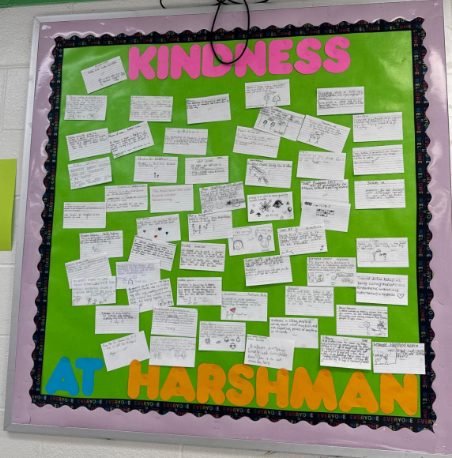
At Harshman, kindness means “doing what you can for others to make a positive impact on our world,” and this isn’t just a platitude on a poster. In advisory, every class developed its own definition of kindness, filling notecards with words, images, and phrases that reflected their experiences. Student council members then sorted through the submissions, identified common themes, and shaped them into a shared definition. The result now lives in the cafeteria as a neon green bulletin board — a central visual made up of hundreds of student voices, all contributing to what kindness looks like in their community.
In 2026, now in their fourth year with Teach Kindness, Harshman has moved beyond individual lessons to a sustained kindness practice. Harshman has embedded 17 Teach Kindness lessons into a cohesive unit within their Advisory structure — not one-off activities, but a through-line that shapes how both students and teachers talk about inclusion, tone, conflict, and community week after week.
As 6th-grade Advisory teacher Kendall Crone put it: “I’ve taught lessons on kindness before, but the Teach Kindness discussion prompts opened the door to deeper, more meaningful conversations. The topics felt timely and relevant to my 6th graders, and it was clear they were connecting the ideas to their real lives.” After teaching the Good and Bad Teasing lesson to her sixth graders, veteran teacher Ms. Crone said it gave her language for dynamics she’d been observing for a year and a half.
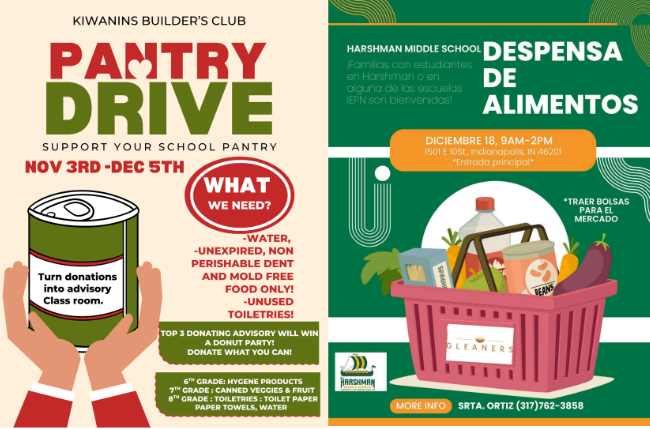
In November 2025, when students recognized that their community faced growing rates of food insecurity, they turned kindness into action and rallied around the school’s food pantry as a schoolwide Kindness Project. As needs increased, the district approached Harshman about expanding access to families beyond the school, and students rose to meet the moment. One sixth grader, Micah, was overheard urging his classmates to step up, reminding them that even his sister’s elementary school was now relying on Harshman’s pantry. “We’ve got to get as many items as we can,” he said. Within weeks, that sense of shared responsibility translated into real impact: the pantry more than doubled the number of families it served, growing from about 15 to over 30 each month.
Assistant Principal Jack Hesser put it simply: students used to see themselves and the Harshman community as separate things, and now they don’t. At a recent open house, a student told prospective families: “It’s not ‘how do I be a part of the Harshman community’—I am the Harshman community.” At a school that had to rebuild itself almost entirely from scratch, that might be the most powerful outcome of all.